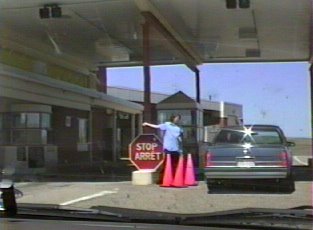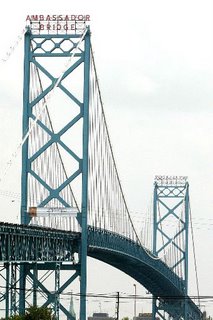
Tuesday, November 15, 2005

Bordering On The Sublime Or ...


What a day yesterday was. A whole range of emotions from gloating over a seeming victory to worrying about what will happen next. I’ve been there before with Council resolutions that meant little to bureaucrats who were the “decision-makers,” quiet by-law changes that almost thwarted the will of the Community, and announcements by a Prime Minister and Premier that seemed to give hope but then seemed to be ignored.

Let’s get out the good news first. This was a total victory for the group I founded, OJIBWAY NOW! and for the group of which I was General Counsel previously, STOPDRTP and the Windsorites who supported us so strongly for almost 3 years now.

DRTP should be dead, finally! As was clear for years now:
  • “The capacity provided by the Detroit River Tunnel Partnership (DRTP) two-lane truckway proposal was determined to be inadequate to serve the region’s long-term needs.

    It was also determined that a six-lane freeway following the Canadian Southern (CASO) Rail corridor in Canada, to a new river crossing, would have caused major community impacts in significant urban areas on the Canadian side of the border.

As for the new crossing, the obvious corridor was picked—OJIBWAY! What more needs to be said.

The big surprise to me was that only one corridor was chosen and that both DRTP and the Twinned Bridge were killed off now. Did someone in Government get guts finally? I had heard rumours of this decision for several weeks now including that our Cabinet members/MPPs, Sandra and Dwight, were to make the announcement last week! I guess someone decided that we Canadians were “courteous” after all and that we should not try to out-Granholm Granholm and follow proper etiquette.

I expect the inevitable risk of lawsuits will happen as the losing parties threaten legal action. That is my biggest worry that may delay the process.

What else can one say after DRTP’s Marge Byington’s press release the day before Kwame was re-elected. The threat is there. I frankly doubt if DRTP will sue since they would probably never get their connection to I-75 if Kwame had his way after Marge’s comments against him in Today’s Trucking magazine.

The Bridge Co. might be angry but for different reasons. Why the Twinned Bridge was killed off when it was ranked highly as well is the big mystery to me. The reason given---"twinning the existing Ambassador Bridge was determined to not be practical based on the community impacts of the proposed plaza and access road in Canada"---makes little sense to me. Obviously, the plaza location the Bi-national identified for the Twinned Bridge killed that project but the Bridge Co. never supported that location at all as far as I recall. Strange!

But it is more than that. The Bridge Co. owns most of the the land on both sides of the border where the crossing goes and they "own" the business now across the border, especially the truck traffic. They are not going to give up their operations to anyone without a fight or a very big cheque.

And if one wants to talk politics, the Michigan Governor and Detroit Mayor like the Bridge Co. for the developments proposed and jobs to be created on their side.

The biggest losers have to be Mayor Francis and the Councillors. According to the Mayor, he was briefed today on the decision. So much for Windsor having a seat at the table and being a partner in the process.

It is just dessert for a Mayor who can now be seen to have wasted so much time, effort and taxpayer dollars on a short-term billion dollar dream that made no sense instead of rallying Windsorites for the long-term, Ojibway solution. Imagine where we would be now if the Mayor and Council had truly focused on the reasons for which they were elected.

Of course, heaven forbid, the Mayor may still try and salvage his Tunnel dream. A strong argument can be made that the Tunnel’s value has been diminished greatly by today’s announcement so that may no longer be possible. Therefore, Council can get back to running the city and not a border crossing, as exciting as that may be!

Oh watch the Mayor get on his high horse about trucks on E C Row, even temporarily (or he might even cave in on that to save face with the Senior Levels). No one will say that the route chosen by the Bi-national was effectively that identified by the Bridge Co. as part of their solution and they NEVER suggested putting trucks on E C Row during construction.

So what should be done now? We will have to determine if a new crossing is really needed with the fall in traffic or if needed, when it should be built. I see the language---“The Partnership will continue to explore the U.S. customs plaza area of the Ambassador Bridge to connect to a potential customs plaza on the Canadian side in the remaining area of continued analysis”---which may mean that the 200 booth proposal is on the table finally and with reverse customs. We need to assess what the impact of a new crossing will be on existing crossings since we do not want to bankrupt them, especially the City-owned Tunnel.

Assuming that the 200 booth proposal works for 20-25 years, or even if it does not and we decide to build now, we need to identify exactly and protect the corridor to the new crossing. Quoting from the letter I and my colleagues sent to the Mayor and Council back in December 2003:

  • "We offer the following solution:
    -Provide a by-pass away from the densely populated areas of Windsor to a new bridge focusing on the Ojibway West corridor
    -Commence the environmental assessment of Hwy. #3/ Huron Church Road from Howard Avenue to the E.C. Row Expressway interchange and the Ojibway West Corridor immediately
    -Commence engineering work on the Ojibway West Corridor to determine the best routing to minimize impact
    -Expropriate/move the Ambassador Bridge Co.’s Montreal-to-Tijuana truck traffic for the benefit of the Community in a manner consistent with other such actions by the City [when required]
    -Utilize the Ojibway West Corridor and the new bridge for this international truck traffic
    -Use the existing bridge for car and local international truck traffic only to give local businesses, the tourist trade and commuters an advantage.
    -Immediately start a dialogue with the relevant stake-holders including citizens groups, Governments, the Ambassador Bridge, to deal with how we are going to accomplish this solution in a timely manner.

    Our solution accomplishes many objectives that support the economy, international trade and protects Windsor:

    1. It meets the needs of our region and the nation’s economy now
    2. It gives our area an economic advantage for diversity and the economic boost it needs
    3. Huron Church Road from the E.C. Row Expressway to the foot of the Ambassador Bridge can be turned into a new Windsor destination centre
    4. It moves the Montreal-to-Tijuana trucks out of the densely populated areas and can help keep them off city streets.
    5. Highway 401 is finally completed to the border
    6. E C Row is preserved for the Community
    7. Our suggested corridor to the border would not result in major traffic congestion and therefore not interfere with ongoing cross border traffic so vital to the Canadian economy.
    8. Our routing can be set up as a secured corridor to support the anti-terrorism initiatives of the Canadian and U.S. Governments
    9. While our corridor is designated as a truck route, it could be used for auto traffic redundancy if an emergency situation arose."

Monday, November 14, 2005

Windsor In Goodale's "Budget"

For Canada, Asia-Pacific’s emergence as an economic powerhouse spells opportunity if—and only if—we are prepared. This government has already begun. As announced in October, we are ready to invest $590 million in the further development of our Pacific gateway to ensure that our country is positioned to capitalize on these new opportunities.

To better connect rural, remote and Aboriginal communities to global networks, we will invest $100 million to extend broadband services.

We will also build on our strong trading relationship with the United States through, for example, the Windsor-Detroit corridor and improved cooperation under the North American Security and Prosperity Partnership.

BORDER RESULTS

WINDSOR – The governments of Canada, the United States, Ontario and Michigan announced today that they have made significant progress towards developing a new river crossing at the Detroit-Windsor Gateway.

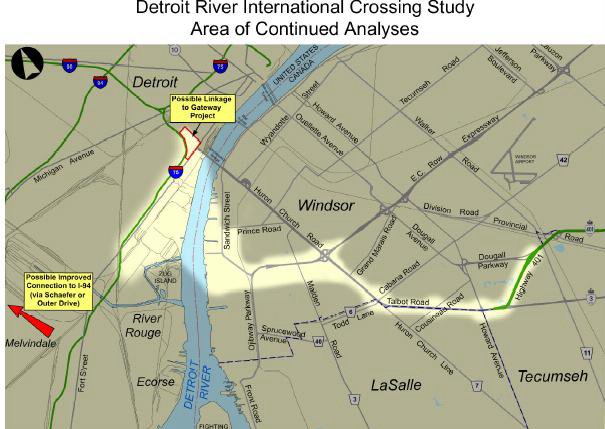
Applying the evaluation criteria jointly established in May in both Canada and the United States has led the Border Transportation Partnership to concentrate future study of a new border crossing and inspection plazas to the industrial area of West Windsor. This area extends north generally from Broadway Boulevard to the vicinity of Brock Street on the Canadian side and a corresponding area on the U.S. side extending upriver from Zug Island to just south of the Ambassador Bridge.

As part of the next phase of environmental studies, the Border Transportation Partnership will consider all aspects of developing the border crossing system, which includes a river crossing as well as appropriate customs plaza locations and connecting roads on both the U.S. and Canadian sides of the border. Further detailed study, technical analysis and public consultation will be conducted to identify the best end-to-end solution within this area.

With this announcement, the Partnership is on track to identify the preferred location of a new river crossing by mid-2007, with final completion of all U.S. and Canadian environmental studies by the end of 2007. The environmental review requirements of both countries have been, and will continue to be, carefully applied throughout this process.

“Today the Partnership has taken a major step forward in the planning process to develop additional border capacity at the Detroit-Windsor Gateway,” said Federal Transport Minister Jean-C. Lapierre. “Canada shares a dynamic multi-billion dollar trade economy with the United States, and it is important that we continue to move forward on this project in both a practical and timely fashion to ensure no disruption to the safe, efficient and secure movement of people and goods across the border in the Windsor-Detroit area.”

“Relieving border congestion is a top priority for the McGuinty Government,” said Ontario Transportation Minister Harinder Takhar. “Forty-one per cent of Ontario-U.S. trade flows through the Windsor-Detroit border crossing, making it Canada’s premier trade gateway. We look forward to public and stakeholder input as a vital part of the ongoing Environmental Assessment process.”

"The Border Transportation Partnership is a strong, respectful collaboration between the United States and Canada. Together we have taken another important step toward concluding this study. Now we will continue our commitment to public participation and input during our careful analysis of impacts and options as we move forward to provide safe, efficient border crossings that strengthen our regional economy and quality of life,” said Gloria J. Jeff, Director of the Michigan Department of Transportation.

The Canada-United States-Ontario-Michigan Border Transportation Partnership is comprised of technical experts and officials from Transport Canada, the U.S. Federal Highway Administration, the Ontario Ministry of Transportation and the Michigan Department of Transportation. The Partnership’s purpose is to improve the movement of people and goods across the United States and Canadian border in the Detroit-Windsor Gateway.

In October, the government partners announced that the south and east alternatives were eliminated from further study as the result of analysis. With today’s announcement, additional crossing alternatives have been eliminated:

The capacity provided by the Detroit River Tunnel Partnership (DRTP) two-lane truckway proposal was determined to be inadequate to serve the region’s long-term needs.
It was also determined that a six-lane freeway following the Canadian Southern (CASO) Rail corridor in Canada, to a new river crossing, would have caused major community impacts in significant urban areas on the Canadian side of the border.
Alternative crossings in the Morton Industrial Park area in Windsor were determined to not be practical because the proposed U.S. plaza site in River Rouge would have resulted in significant economic impacts and time delays.
Twinning the existing Ambassador Bridge was determined to not be practical based on the community impacts of the proposed plaza and access road in Canada. The Partnership will continue to explore the U.S. customs plaza area of the Ambassador Bridge to connect to a potential customs plaza on the Canadian side in the remaining area of continued analysis.
The start of the formal environmental review was announced in February 2005. In June 2005, the Partnership presented the 15 alternative locations for river crossings, along with the associated customs plazas and roadways to connect the plazas to the freeway systems in both countries. Eight other options, including southerly routes through LaSalle, and Amherstburg, Ontario and communities extending south from Ecorse to Trenton, Michigan, and the area upriver near Belle Isle, were eliminated in early October 2005.

The Border Transportation Partnership will soon hold public meetings to present the technical assessment to date, and seek public and stakeholder comment on the preliminary list of practical alternatives. Public Information Open Houses are scheduled in the Windsor area during the week of November 28, 2005 and public meetings are scheduled in the Detroit area during the week of December 5, 2005. In March, the Partnership will hold Public Information Open Houses and public meetings in Canada and the United States to present a final list of practical alternatives.

The Governments of Canada, the United States, Ontario and Michigan are committed to an efficient and secure Windsor-Detroit gateway. The development of additional border capacity is a national priority in both countries to support the continued growth in trade between Canada and the United States.

Sunday, November 13, 2005

The Border According To The Toronto Star


For those that want a relatively straight forward feature news story about the border, take a look at the Toronto Star article published below. There are several obvious errors:
  1. 1) The Bridge Co has a monopoly (the Bi-national killed that one years ago)
  2. 2) Chronic delays at the Bridge (not since it opened more booths)
  3. 3) There's another big one, made over a dozen times (let's see who can spot it)
  4. 4) The Bridge is close to capacity (only about 50-60%)

However, it does point out the most important fact that our Mayor and Council seem to have forgotten or are afraid to deal with: "if you want to build a new crossing over or under the Detroit River, you're going to end up having to deal with Maroun."

It is interesting that the other proponents have pretty much conceded the battle to the Bridge Co. as well:

  • [Marge Byington of DRTP] has, over the years, come to know this spot well, a place to gaze directly at a seemingly grand business opportunity. "I used to come up here and sit," she says.
  • "Support for the DRTP soon started evaporating"
  • So has [Ross] Clarke [of Mich-Can] wasted 14 years pursuing the project? "It could end up that way, yeah, could be."
  • The [Cansult] report did not warm to the [Schwartz] horseshoe road and its marshalling yard, a combination Cansult deemed not to be "practical or cost-effective." Indeed, Cansult reckoned the cost of tunnelling under the nature preserves with boring machines might itself prove "exorbitantly expensive." This was not happy news for Francis, who's spent much of this year trying to get Ottawa to agree to a full federal-provincial environmental assessment of the Schwartz plan, to no avail
  • "He's got it so close to checkmate," says [Greg] Ward [of the Detroit-Windsor Truck Ferry]. "He's that close, man."
  • All roads would now lead to Maroun, who got an added boost in last week's election when Detroit's Maroun-friendly mayor, Kwame Kilpatrick, beat out rival Freman Hendrix, whose affections lie with the Jobs Tunnel.

Enjoy the read!

Billionaire's bridge
Nov. 13, 2005. 07:05 AM
KENNETH KIDD
FEATURE WRITER (Toronto Star)

Marge Byington, her blonde-grey hair tied back in a ponytail, is standing on a railway overpass, the rain drizzling onto her black sweater and slacks. She has, over the years, come to know this spot well, a place to gaze directly at a seemingly grand business opportunity. "I used to come up here and sit," she says.

Several hundred metres away to the south, the rail line dips down into a two-lane tunnel, above which, cast in concrete, is the legend: "Detroit River Tunnel 1909." From there, it continues southward, under the water, until it emerges on the Canadian side in Windsor.

The tunnel's two lanes were round when built, but they've since been altered to accommodate slightly taller, more modern trains. This was not an artful renovation: The concrete above the tubes was simply cut and chipped away, so each opening now looks like a small rectangle perched on a circle.

More substantial changes could one day ensue. Or not.

Byington's group — a joint venture between CP Rail and the Ontario Municipal Employees Pension System — hopes to transform the old tunnel into a highway for trans-border trucks. They call it the "Jobs Tunnel," a way of advertising its claimed economic boost.

Sometime this month, a bureaucratic Canada-U.S. panel — dubbed The Border Transportation Partnership, then needlessly renamed the Detroit River International Crossing study, or DRIC, but known locally as simply "The Bi-National" — will unveil a short list of four proposals to add another border crossing for trucks. A prizewinner won't be crowned until 2007. Construction would be completed by 2013. At least that's the plan.

As it happens, most of these ideas for new crossings have keen kicking around in one form or another for at least a decade, ever since the economic burst of free trade started clogging up Windsor streets with trucks waiting to cross into Detroit.

But there have been, well, complications along the way. The other short list reads like this: complicated political intrigues, proposals and counter-proposals, NIMBY neighbourhood fighting, and enough players to fill a season at Stratford — all with a jurisdictional overlay of local, provincial, state and federal authorities, a group not known for easy unanimity.

At one point, a veteran of the crossing battles counted more than 60 agencies that might come into play.

All this might aspire to farce were the economic consequences not so potentially dire. Fully one quarter of all merchandise trade between Canada and the United States now passes through the Windsor-Detroit corridor. The cost of delays and disruptions along that path soon adds up to hundreds of millions of dollars.

Hence Byington's occasional desire to sit on the overpass to plot strategy, not least about one complication in particular.

Underneath her is Interstate 75, and the view to the west eventually gives way to the 76-year-old Ambassador Bridge, which is where trouble both begins and may, ultimately, end.

As it now stands, the bridge is the only major truck crossing in this part of the world, a dizzy monopoly through which roughly 12,000 trucks now pass daily, paying (together with cars) an estimated $60 million (U.S.) in annual tolls.

Now add another distinction: Of the more than 130 border crossings between Canada and the U.S., it's the only one owned by a private individual, a 78-year-old trucking magnate named Manuel "Matty" Maroun. (The only other non-government crossing, at Fort Frances, Ont., is owned by two publicly traded forest companies.)

"We're dealing with a monopoly here, a private monopoly, and the bridge company does an extremely good job of protecting that monopoly," says Byington, one-time aide to former Detroit mayor Dennis Archer.

When the Jobs Tunnel purchased a strip of land next to the rail line here, the group ended up in a protracted (though recently successful) court fight with Maroun, who happens to own the adjacent and windowless Michigan Central Depot, a once grand 12-storey train station built in 1913, through which generations of soldiers departed for war, including Byington's Vietnam veteran husband.

Maroun has an affection for such piles. He also owns a handful of other derelict buildings nearby, as well as vast swaths of riverfront and what used to be Detroit's industrial core. "They have no windows," says Byington. "You can always tell."

But all that land also means that, if you want to build a new crossing over or under the Detroit River, you're going to end up having to deal with Maroun.

--------------------------------------------------------------------------------
Windsor itself may be flat as the prairies, but its man-made geography has a certain surreal quality, not least a weird penchant for highways that lead nowhere and then end abruptly.

A half-century ago, local opposition stopped Highway 401 on the outskirts of Windsor, 12 kilometres away from the Ambassador Bridge. Nor does the 401 come anywhere near the E.C. Row Expressway that cuts east-west across the city and which also sputters onto urban streets at either end.

Once the 401 comes to a halt, any trucker heading to Detroit must follow two city streets — Talbot Rd. and then Huron Church Rd. — through 17 traffic lights to get to the bridge, where there is a single lane for trucks in each direction. This is not a design they teach in university.

For decades, though, it was scarcely a problem. The Ambassador Bridge, which opened 76 years ago next week, was never built with a lot of truck traffic in mind, and by 1961 only 800 trucks were crossing it daily.

Apart from the griping about tolls, the bridge was rarely in the spotlight — one of those times being when Matty Maroun happened along to buy it in 1979.

Ever since the Depression, when the bridge's original owner sold shares to stave off bankruptcy, the Ambassador Bridge had been owned by a publicly traded company. By the late 1970s, one of the biggest investors was the legendary Warren Buffett, with 25 per cent of the stock. But Maroun, a Detroit native backed by his family's trucking business, matched that stake, bought out Buffett and then the remaining shareholders for $30 million (U.S.).

If you wanted to script a billionaire who still throws Gordie Howe elbows like the scrappy entrepreneur he once was, Maroun wouldn't be a bad model. His Arab grandfather was peripatetic enough to move the family from Argentina to Quebec to Windsor, where the family home was razed to make way for, yes, the Ambassador Bridge.

Maroun's father ended up in the trucking business in 1950 after he took over Central Cartage, a struggling company that owed him back rent. Matty did the books and any other odd job that needed doing, from changing oil to fixing tires. As the only son, Matty naturally ended up overseeing the business — though he later had to fight to keep it, when two of his sisters sued him over the way he was running the company. They finally settled in 1999, when Matty bought them out.

He has always had, it seems, a troll-like possessiveness about the bridge, insisting (often in court) on its private status. He won't release maintenance records and refuses to let law enforcement officials onto the bridge to nab trucks that could be carrying explosives, toxic waste or other materials banned by law from crossing the bridge.

About his personal life, he's equally protective. Maroun doesn't grant media interviews, rarely appears in public, and his officials did not return phone messages. His relative obscurity, in fact, might have survived intact were it not for two events: the Canada-U.S. free trade agreement and the 9/11 attacks on the World Trade Centre.

By the early 1990s, truck traffic had already swelled to 8,000 trucks daily, en route to an eventual peak of 14,000, testing the bridge's capacity and backing trucks up along Huron Church Rd. in Windsor.

Then came 9/11. Amid the security crackdown that followed, the backup stretched for kilometres, hinting at the havoc any terrorist attack on the bridge would wreak. On some days it took 12 hours for a truck to get from Windsor to U.S. Customs on the other side, prompting the Ontario Ministry of Transportation to place portable toilets all along Huron Church.

None of which surprised Ross Clarke, a local surveyor and former head of the Windsor Chamber of Commerce, who'd been warning about the economic cost of such traffic jams since 1991, when he and a group of local businessman first proposed building a second crossing to relieve the pressure.

The need was already clear back then. "If something wasn't done, there was going to be a diversion of economic activity. Companies weren't going to come to Windsor or Detroit."

Clarke's group called themselves Mich-Can. They picked a site in Windsor's industrial west end, brought in the engineers, and lined up Bear Stearns to do the financing. Windsor city council seemed to be receptive.

There was just one problem: Although Clarke's proposal was simply to build a new bridge, the project assumed that the 401 would eventually be connected to E.C. Row, which just happens to run in a direct line toward their new crossing. As traffic grew, they figured, E.C. Row could easily be expanded to eight lanes from four. There'd be no trucks on city streets. "From an engineering point of view, the E.C. Row expressway makes sense to anybody from out of town because it's a controlled-access route," says Clarke.

But if there's one taboo in Windsor — and a curiously masochistic one, given the city's reliance on the auto industry — it's putting more vehicles on E.C. Row. The highway to nowhere affects the ward of every local councillor, so worries about noise and pollution rarely fall on deaf ears. As soon as everyone figured out what the new bridge would entail, Mich-Can's idea was shunted to the wings, where it's lingered ever since.

Sure, the Mich-Can site is still on the short list being studied by the Bi-National commission on a new border crossing, but even if that site emerges victorious, there's no guarantee Clarke's group would win the right to build the bridge there.

So has Clarke wasted 14 years pursuing the project? "It could end up that way, yeah, could be."

--------------------------------------------------------------------------------
Lou Tortola hauls out an aerial photograph of his part of Windsor. "This is my house right here," he says. "From my backyard, I could throw a snowball and hit a truck."

Not just any truck, mind you, but what could be thousands of them heading along what is now a railway line if Byington's Job's Tunnel, a.k.a. the Detroit River Tunnel Partnership, ever gets its way. "If this DRTP goes through, our neighbourhood goes to ratshit."

It didn't help that the DRTP was a well-oiled publicity machine, with former Windsor mayor Mike Hurst emerging as its head. "I don't want this forced into our community by people who have more money than God," says Tortola.

He's especially galled at one publicity stunt — the time a CP train, with Santa Claus on board, slowly made its way through town and over to Detroit, collecting contributions for a local food bank.

The DRTP's Byington might recall that event as a touching affair, but not so Tortola. "It was the worst American bullshit campaign you've ever seen in your life," he says. "I just went nuts. I can't believe they had the balls to do that."

Not that Tortola is unfamiliar with campaigning. He worked as (now) Ontario Finance Minister Dwight Duncan's campaign manager in the 1995 provincial election and runs a local marketing firm, designing websites and the like. Which is to say, a well-oiled anti-DRTP campaign was inevitable, much of it orchestrated by Tortola.

There were lawn signs — "like a federal campaign, really" — and town-hall meetings and letter-writing campaigns. The group boasted 1,200 members at its height, and raised roughly $21,000.

Support for the DRTP soon started evaporating, but Tortola's group spawned such a taste for change that it eventually ushered in a slew of new city councillors, along with a new mayor.

That would be Eddie Francis, now 31, late of the family pita business started by his Lebanese immigrant father. Francis the younger has staked much of his short public career on solving the border problem — a brave and worthy thing to do, but also the kind of stand that, for politicians, is often eventually accompanied by grief.

For starters, Francis still can't understand why the rest of the country hasn't really cottoned on to the border problem in Windsor, which is where 40 per cent of all the trucks entering Canada from the United States make their crossing.

"I don't think others have an appreciation of what impact it has on them," says Francis, wielding one of those laser pointers so he can highlight parts of the slide show he's got going in his office boardroom. "Toronto has more at stake on the Windsor crossing than it does on the Peace Bridge." The Francis laser alights on how nearly half the bridge's truck traffic is long distance — shuttling between factories and showrooms throughout southern Ontario and their U.S. counterparts well beyond Detroit.

Still, Francis figured Windsor would have to resolve its own internal conflicts first, so he turned to former New York City traffic maven Sam Schwartz, the guy credited with coining the word "gridlock."

Francis figured if anyone could come up with a plan, it was Gridlock Sam, hired by city council in early 2004.

--------------------------------------------------------------------------------
The night the Schwartz plan was made public last spring, at a town hall meeting in Windsor, a crisply suited Francis took to the stage to do the introductions. He also had a caution, and like many young politicians seeking a gravitas beyond their years, he quoted wartime Churchill: "This is not the end. It's not even the beginning of the end. But it is, perhaps, the end of the beginning."

Schwartz, he noted, was an independent voice, though that hadn't stopped Windsor council from giving him "principles" to abide by, such as getting trucks off city streets, protecting neighbourhoods, and not unduly disrupting the local automakers.

The result was what you'd expect: a consultant's report highly cognizant of local politics. No, Schwartz wasn't proposing to clog E.C. Row with trucks. There are already too many off ramps, he said, often only 700 metres apart, much less than the provincial standard of two kilometres.

Nor was he fond of the Jobs Tunnel. He called it a cattle chute, with so little side-clearance for trucks there were bound to be accidents — and idling trucks backed up into the heart of Windsor.

Schwartz had a plan of his own. Trucks would continue to flow off the 401 onto Talbot Rd./Huron Church, but they'd be intercepted partway and diverted onto a giant horseshoe road that would swing toward the Detroit River where it bends southwest. In other words, right where Clarke's Mich-Can group long ago proposed putting a new bridge.

But until the new crossing gets resolved, the trucks would enter a marshalling yard, where they'd be "metered" — released at set intervals — to continue along the horseshoe and back onto, well, Huron Church.

Having travelled eight kilometres along the horseshoe — to avoid a two-kilometre stretch of Huron Church — trucks would then still have to pass the remaining 10 traffic lights approaching the Ambassador Bridge. But Schwartz insisted metering would still make for orderly traffic, since no trucks would be released if there were any tie-ups at the bridge itself.

There were other parts of his plan, too, like adding a major rail terminus to the airport area, but the key was the horseshoe, with an estimated price tag of $300 million. "You should not be afraid to think big and demand big," Schwartz told the assembled that night.

Toward the end of his presentation, he spoke of "generational ethics," creating something of value for the future. He said Windsor deserved a "signature bridge." A portrait of London's Tower Bridge came up on the screen.

There followed an artist's rendition of Huron Church, with trees and cyclists. "They will call the Champs-Elysées the Huron Church Rd. of Paris. That's how great it's going to be."

There was, oddly, no one rolling in the aisles.

--------------------------------------------------------------------------------
There's a simple reason that Schwartz's horseshoe road was so warmly received when first unveiled to a Windsor audience: The homeowners who might be most hostile don't live in Windsor. They live in the adjacent town of LaSalle, near a group of noted nature preserves, including Ojibway Prairie Provincial Nature Reserve and Tall-grass Heritage Park (owned by the Nature Conservancy of Canada).

As it happens — and this shouldn't surprise, given Windsor's history of road design — Schwartz's horseshoe road would run through and under the Ojibway Reserve as well as Spring Garden, a provincially designated "Area of Natural and Scientific Interest."

"It was pretty clear to us right away that it was a pretty expedient political decision: Let's put it through the forest," says Alan McKinnon, walking through the wild parkland behind his house.

McKinnon, production director at a local rock station, has since been spearheading a "Save Ojibway" campaign, with brochures, letters to politicians, T-shirts, and support from a raft of environmental groups.

He concedes some of the most endangered inhabitants of Ojibway — grey foxes and Massasauga rattlesnakes — are not the cuddliest critters around which to build a campaign. But in the end, he may not need them.

Not long after the Schwartz report, Ontario Premier Dalton McGuinty and Anne McLellan, the deputy prime minister, arrived in town to unveil a major road expansion, much of it through farmland near the airport in east-end Windsor. That roadwork would wind up connecting the 401 with E.C. Row.

Francis was incensed. Anything that might put trans-border trucks on E.C. Row is, to him, "a non-starter." So he and the rest of Windsor council snubbed the ceremony. "Had we attended," he says, "we would have condoned it.

"Yes, we've got explosive growth. Yes, things are going well for trade and commerce. But it shouldn't be on the backs and shoulders of Windsor residents. Why are they not entitled to the same quality of life as anyone else in the province?"

Amid all the border woes, the City of Windsor's absence at the ceremony passes strange to Tom Burton, deputy mayor of Tecumseh, an adjacent town east of Windsor, which supports expanding E.C. Row. "It just boggles my mind that they would think they don't need the province and the feds to solve this problem."

Then last month, Transport Canada released a critique of the Schwartz report it had commissioned from Markham's Cansult Ltd. The report did not warm to the horseshoe road and its marshalling yard, a combination Cansult deemed not to be "practical or cost-effective." Indeed, Cansult reckoned the cost of tunnelling under the nature preserves with boring machines might itself prove "exorbitantly expensive."

This was not happy news for Francis, who's spent much of this year trying to get Ottawa to agree to a full federal-provincial environmental assessment of the Schwartz plan, to no avail.

--------------------------------------------------------------------------------
Gregg Ward, a big friendly guy with a killer handshake, is wheeling his silver F-150 along the Windsor side of the Detroit River, playing a familiar game of local trivia. What does Matty Maroun own now?

"Right where you see that blue building over there," he says, pointing across the river. "He just bought that terminal."

There is, for Ward, a philosophical point about Maroun's monopoly. "Should critical infrastructure be privately owned?"

And he's well aware of the irony. Ward's family operates its own species of private crossing, the Detroit-Windsor Truck Ferry, essentially a barge for carrying oversized trucks and those containing hazardous material — or "haz-mat" in industry jargon. It's a tiny business, grossing under $2 million a year. "There's only a certain amount of haz-mat that crosses in a day," he says.

Even if, as Schwartz recommends, his ferry service were expanded to two barges operating 24 hours a day, that would still add up to only 1,000 trucks per diem.

"This is his property, too," says Ward, of a vacant lot on the Canadian side, near where Clarke's Mich-Can group proposed building its second bridge. "Ross Clarke has a great idea, but he doesn't own property."

Ward, like many in Windsor, holds Maroun in a kind of twisted awe — marvelling at how he plays the game, gobbling up all that real estate. "He's got it so close to checkmate," says Ward. "He's that close, man."

As it happens, Maroun's next move comes the following day: The Ambassador Bridge has a new plan, a big finger directed at the whole Bi-National quest for a second crossing. Instead of adding another bridge right next to the Ambassador, as he'd long threatened to do, Maroun now proposes building a giant customs plaza on 80 hectares of Detroit industrial land, most of which he already owns.

There would be 100 customs booths, double the current number on both sides of the border, with the possibility of more to come. According to Maroun's calculations, the new plaza would cut crossing times so dramatically that another bridge might not be needed for, well, another 25 years.

And, in a final flourish, Maroun proposed paying the cash-strapped City of Detroit in a deal to take over management of the U.S. side of the Detroit-Windsor car tunnel, and then funnelling its traffic along a secure corridor to the new customs plaza.

All roads would now lead to Maroun, who got an added boost in last week's election when Detroit's Maroun-friendly mayor, Kwame Kilpatrick, beat out rival Freman Hendrix, whose affections lie with the Jobs Tunnel.

None of which is a surprise to Ed Arditti, a retired Windsor lawyer and now a tireless blogger on border developments. "Maroun's got a business and he's going to protect it," he says, leaning over his kitchen table.

In a way that combines laughter and scorn, Arditti's blog has lately been peppered with words like "hilarious." He reckons Windsor could have worked out some sort of favourable deal with Maroun years ago, but has since squandered whatever bargaining power it once had.

Ironically, he says, all the successful campaigns against various proposals — and Arditti was a big foe of the Jobs Tunnel — may have left the city feeling more empowered than it had any right to be. "We effectively gave our city the balls to say `no' to everyone."

Which has also meant shunning the likes of Matty Maroun.

Arditti shakes his head. "Like it or not, you're going to have to deal with Maroun, and no one seems to want to talk to him," he says. "It's like the Fram commercial: You can see me now or see me later."
Saturday, November 12, 2005

Buzz Off Concessions


Again, we are able to provide you with a document that the mass media does not have the space to reproduce. The CAW statement and resolution make an interesting read.

What is also interesting to read is Buzz Hargrove's statement in the Star.
  • "Hargrove also said "we will not blindly follow this policy but we will not stand idly by and watch the wages, benefits and pensions of our members in this important sector rolled back by auto parts companies."
Does he really mean it or not? Was this big hoopla just to please the rank and file with a wink-wink, nod-nod to management?

I wonder what would happen if the CAW allowed their members to have a free vote on this issue. One friend of mine who is a CAW member told me that he would have cut his pay by a few dollars per hour to save jobs at his auto plant.

Remember my BLOG on September 28 "AUTO JOBS SAVED!" that dealt with the VW plant in Germany and how that plant was saved for workers by wage concessions. Could that ever happen here?

Emergency No-Concessions Statement & Resolution
CAW Auto Parts Conference


St. Thomas, Ont.
November 11, 2005

The North American auto industry is heading into a major crisis. Autoworkers did not cause this crisis. We are more productive than ever. We perform higher-quality work than ever. And our compensation (wages, pensions, and benefits) has grown more slowly than our productivity; so our share of the value-added produced in the industry has declined over time.

The true causes of the crisis are clear. Globalization is a one-way street for North American autoworkers. Offshore imports take up almost one of every four vehicles sold in North America. But North American plants (whether Big Three or transplants) can sell virtually nothing to offshore markets. The resulting one-way flow of imports – over 4 million vehicles last year – is destroying thousands of jobs in Canada, the U.S., and Mexico, and destroying the market share and financial foundation of North American-based automakers.

The North American market share of domestic producers has declined by almost 20 percentage points since 1996. Every lost percentage point equals one more assembly plant that must be closed – along with all the parts plants that used to supply that plant. As long as that market shrinkage continues, the fundamental economic consequences are inevitable: lost jobs, plant closures, huge financial losses, and eventually bankruptcies. Workers didn’t create this problem, and workers can’t hope to solve it through their bargaining.

As usual, however, major corporate and media figures are blaming workers and their unions for this crisis. They don’t let the economic facts get in their way. They sense a moment of opportunity to attack workers and their unions, and turn back the generations of gradual economic progress that explain why an auto job is still a “good” job. The demand for back-breaking concessions at Delphi is just the beginning. If Delphi attains those concessions (either through bargaining or court order), it will lead to an incredible wave of attacks on unionized auto parts plants on both sides of the border – and that conflict will inevitably spill over into Big Three facilities, as well.

U.S. judges are also joining this anti-union crusade. Auto industry employers in the U.S. have become much more aggressive in using bankruptcy law provisions to dismantle collective agreements and attack unions. Several firms have strategically used Chapter 11 protections, supported by anti-union judges, to unilaterally escape their obligations to their workers – including the irresponsible dumping of pension obligations onto a U.S. guarantee system that has been overwhelmed by this deliberate bankruptcy “planning” (which is quite different from “true” bankruptcies). Even in Canada, where our bankruptcy laws do not grant as much power to employers, union members at several firms have been hurt by bankruptcy proceedings. Delphi’s aggressive attack will only make things worse. Part of labour’s response to the Delphi situation must be to fight for fairer bankruptcy laws that preserve the integrity of collective agreements.

The CAW has worked diligently and responsibly to build a vibrant, successful auto industry in Canada. Our plants are second to none in quality and productivity. We’ve participated actively in initiatives (like the Canadian Automotive Partnership Council, CAPC) to address problems and update our auto policies. In our bargaining (in both assembly and parts) we emphasize technology, productivity, and innovation – the keys to our long-run economic success – and our wages and benefits are reasonable given our productivity.

The auto industry is Canada’s most important high-technology industry, our biggest exporter, and the ultimate source of hundreds of thousands of jobs. Auto industry stakeholders have agreed through CAPC to ambitious long-run goals for building this industry (including an official target to expand Canadian parts production – not watch it wither away due to globalization). And all the experts (including the new Canadian Automotive Human Resources sector council) agree that we can build a sustainable industry only by investing in the people who make this industry work – not by attacking them and taking away their hard-earned compensation.

We will move mountains to protect and promote the auto industry. But we will not cut our wages, pensions, and benefits. That will never save our industry: at absolute most, it slightly defers the inevitable. And it would discredit the labour movement that has worked for generations to give working people a fair share of the wealth they produce.

The future shape of Canada’s auto industry will be determined by how we collectively respond to the coming crisis. The CAW will do everything it can to attract new auto investment and preserve good-quality auto jobs in this country. But we will not impoverish our members, or future generations of autoworkers, by fruitlessly trying to “buy” our own jobs. That would be self-defeating. A sustainable auto industry must be built on solid foundations: quality, productivity, innovation, respect for contracts, and fair trade.

Therefore, delegates to the CAW’s special Auto Parts Conference hereby endorse the following emergency resolution:

CAW EMERGENCY NO-CONCESSIONS RESOLUTION

1. The CAW and its local unions will not accept concessions in wages, pensions, or benefits in its auto assembly or auto parts contracts.

2. The CAW and its local unions will not open its collective agreements before expiration because employers want to bargain concessions.

3. The CAW and its local unions will remain open and flexible to work with employers and governments to enhance the viability of Canadian auto plants by investing in new technologies or products, enhancing productivity, maximizing utilization, and improving work practices.

4. The CAW will mobilize all of the resources of the national union to support local unions who are resisting employer demands for concessions, and will oppose concessions using every non-violent option available to us (up to and including demonstrations, occupations, plant shut-downs, and refusing to handle “hot” auto parts).

5. The CAW will step up its fight for a fair auto trade policy to open opportunities for North American auto exports, and control the one-way flow of imports that is the ultimate source of our industry’s crisis.

6. The CAW will continue to fight for fair laws to ensure that collective agreements in Canada cannot be unilaterally rewritten under bankruptcy protection proceedings, and to ensure that pensions and other post-retirement benefits are secured by a combination of private and public commitments.

CAW’s Action Plan to Fight Auto Parts Concessions

1. Resist concessions at all costs: We will demonstrate with actions, when words are not enough, that auto parts companies cannot solve their problems on the backs of their workers through concessions in wages, pensions, and benefits. If this requires demonstrations, plant occupations, strikes, or any other non-violent action by CAW members and their community allies, then the CAW will be ready. Parts makers who attempt to solve their problems by forcibly extracting concessions from their workers, will find their ability to effectively do business in Canada severely constrained.

2. Early warning system: If a CAW-represented plant or employer faces big financial challenges, CAW local and national representatives will meet quickly with company officials to examine the financial and operational facts of the situation and develop an action plan. Financial losses, even severe ones, will never justify concessions. But the CAW will seriously undertake to examine the challenges of distressed companies and consider sustainable workplace changes (such as technology, innovation, productivity measures, and work practices) that could contribute to a genuine solution.

3. Draw government into the solution: In some cases, troubled facilities or companies may qualify for assistance from various government investment or support programs (especially when substantial new investments in technology, skills, or innovation could lay the foundation for a more stable future). The CAW will work closely with government officials where appropriate to stabilize and revitalize troubled facilities.

4. An injury to one is an injury to all: In cases when an automotive supplier transfers production from CAW members who are resisting concessions to non-union or foreign plants, CAW members at auto assembly plants will refuse to handle those re-sourced components.

5. Fighting for fair trade: Anything we do to strengthen our auto plants will be only a temporary “band-aid,” so long as North American governments continue to roll out the red carpet for auto imports – with no requirement that they take back North American-made products in return. Our fight against concessions goes arm-in-arm with our fight to open foreign markets to our products, our fight to stop the Canada-Korea free trade deal, and our fight to require all automakers to create jobs in Canada as a condition of their access to our market.

6. Saving our pensions: Plant closures or bankruptcies may jeopardize the future pension or post-retirement health benefits of CAW members. The CAW will enlist its Union in Politics Committees and other allies to campaign forcefully to protect the pensions and retirement benefits of CAW members affected by the fight against concessions, and to step up the fight for stronger policies to protect pensions.

7. Expanding union protection: In non-union plants, workers have little opportunity to fight unilateral concessions – the employer simply dictates them. And by attempting to leap-frog below even non-union wage levels (at $9 per hour wages, the Delphi cuts would push non-union companies to impose wage concessions), Delphi is telling all autoworkers in North America – not just union members – that their wages are too high. If unorganized auto parts workers have any hopes of resisting that race to the bottom, they have to join the union, and the CAW will step up its efforts to help them do so.

Friday, November 11, 2005

Laughing Themselves Silly


Two people must be in a very good mood today after reading the Windsor Star major front page stories. It just cannnot get any better than this for them both.

The first one has to be the head of the Economic Development office in London, Ontario (or really the head of any such office in SW Ontario or SE Michigan) competing against Windsor for new jobs and plant locations.

Can you believe it, Customs union workers at the bridge and tunnel backing up traffic for miles and for hours. Then the CAW is bringing in leaders from across Ontario to debate an emergency no-concessions resolution and a seven-point action plan to fight concessions at parts companies.

Ahhh, the remarks of the CAW Union heads are enough to make anyone smile when jobs are the prize for your Community: "We have to preserve the sanctity of the collective agreement," said Renaud." "We're not going backwards," said Lewenza."

The other person who is chuckling has to be the head of the Bridge Co. He can legitimately say today "It's the Customs, stupid!" In other words, we have positive proof that they were right when they said that all we need are booths open to prevent backups at the border.

The Star reported that only four lanes, less than half the usual nine, were open at the Tunnel during the afternoon rush hour, and only 12 lanes, compared to the usual 17 to 19, were open at the Bridge. Once the booths were opened and staffed properly, the backups eventually disappeared.

Hmmmmm I wonder what 200 booths would do. Perhaps with traffic declining or not increasing so dramatically as has been projected, we may not need a new border crossing for years to come.

Canada Customs A Floppola


Poor Mark Boscariol! Expecting some boffo reviews of his new Windsor International Film Festival, instead he got bad news. On the night of his Gala, because of a labour dispute at the border, traffic entering Canada was tied up for miles at the border and it took as long as an hour or more to clear Customs. How many Americans chose not to come over and buy tickets and how many who bought them will now demand a refund.

I saw coverage of the dispute on WDIV, WWJ and the Free Press and across Michigan. Here's what WWJ said:
  • "A labor dispute in Canada caused major traffic problems in Detroit and Port Huron Thursday.

    Canadian customs officers refused to work, saying their jobs aren't safe. They want guns to protect themselves and to prevent potentially dangerous people from getting into Canada. Marie-Claire Coupal of the Customs and Excise Union says they can't defend themselves against people who may be armed and dangerous, or stop them from entering Canada. Coupal says officers typically let them through, then call Windsor Police.

    Danny Yen of the Canada Border Services Agency says they commissioned an independent study a few years ago which showed that officers do not need to be armed.

    But because the officers exercised their legal rights to refuse work, their managers had to run the booths at the Ambassador Bridge, the Blue Water Bridge, and the Detroit-Windsor Tunnel. Yen says that left the border crossings understaffed, and that caused delays which spilled onto major roads and freeways in Detroit and Port Huron."

I sympathize with the Customs Officers..it IS a dangerous job at the border. However, as the OTA pointed out:
  • "Customs inspectors at the Peace Bridge have walked off the job five times since May citing personal security concerns and exercising their right to refuse work under the Canada Labour Code. Apparently, some of the inspectors want to be armed like their US counterparts. Each time the union workers have walked off the job, Human Resource and Skills Development Canada ruled that there was no threat to personal safety and forced the customs inspectors back to work."

Obviously there is an unresolved dispute between the workers and management but who suffers, the public. The trucking industry claims losses of a million dollars an hour. Our tourist trade and businesses suffer as the perception will again arise in the minds of Americans that it is foolhardy to cross the border into Canada. Does anyone think that Detroiters are going to put up with their Interstates being tied up and its Downtown jammed with cars and trucks waiting to be cleared into Canada.

I have no idea who is right or wrong in the dispute but one of the parties is mistaken. That party's actions are jeopardizing the economic health of this country. It must be stopped now.

I disagree with the OTA's solution: "trucking companies to charge their customers for delays their trucks are experiencing getting back into Canada." Rather OTA, given the strong industry group that it is, should, on behalf of its members, sue both the Union and the Government for the losses incurred. If the bargaining process cannot resolve the dispute, then let the courts do it.

And if OTA will not, Mark should consider doing so!